
Otero County Criminal Docket Searches
Begin free of charge at New Mexico Courts Case Lookup. Clear its current captcha. Then run the live form with a full case number or a name. The official search help covers first and last name queries. An optional middle name can be added too. It lists ways to narrow results, such as court type, location, category, date range, and date of birth where the live search allows. The legacy criminal label is CR. Current category labels should be read straight from the portal.
Know which court is named on the citation, release paper, summons, or notice. Decide that before you type anything. A complete case number is far more precise than a common name. New Mexico's published example, D-101-CR-200600001, breaks out court level, location, category, year, and sequence. It is not an Otero code to copy or infer from. Keep the number exactly as the court issued it.
- Open Case Lookup and complete the anti-automation prompt.
- Enter the complete case number, or use the full name and available narrowing details.
- Check that the returned court, location, and criminal category match the paperwork.
- Read the dated register entries and note the latest future setting or disposition entry.
- Use the schedule and the correct clerk to resolve a missing, conflicting, or incomplete result.
Note: a public register result is a helpful starting record. It does not replace written notice or the clerk's confirmation of a current criminal setting.
Otero Felony Criminal Dockets
Felony trials and later felony proceedings sit on the Otero County District Court docket. Its address is 1000 New York Avenue. The court also takes criminal appeals from lower courts where that applies. A felony may open with a Magistrate Court preliminary proceeding. Two related court records can exist at different stages. That lower filing does not hand Magistrate the whole felony case.
The Twelfth Judicial District judges page names the District and Magistrate divisions serving Otero. The split matters for any criminal docket search: the felony trial entry belongs to District Court. A preliminary hearing may show up first downstairs. Keep both numbers when an appeal or transfer opens a second docket trail.
The Twelfth District court and judge listing supplies the official page. That page stands behind this Otero criminal docket image.
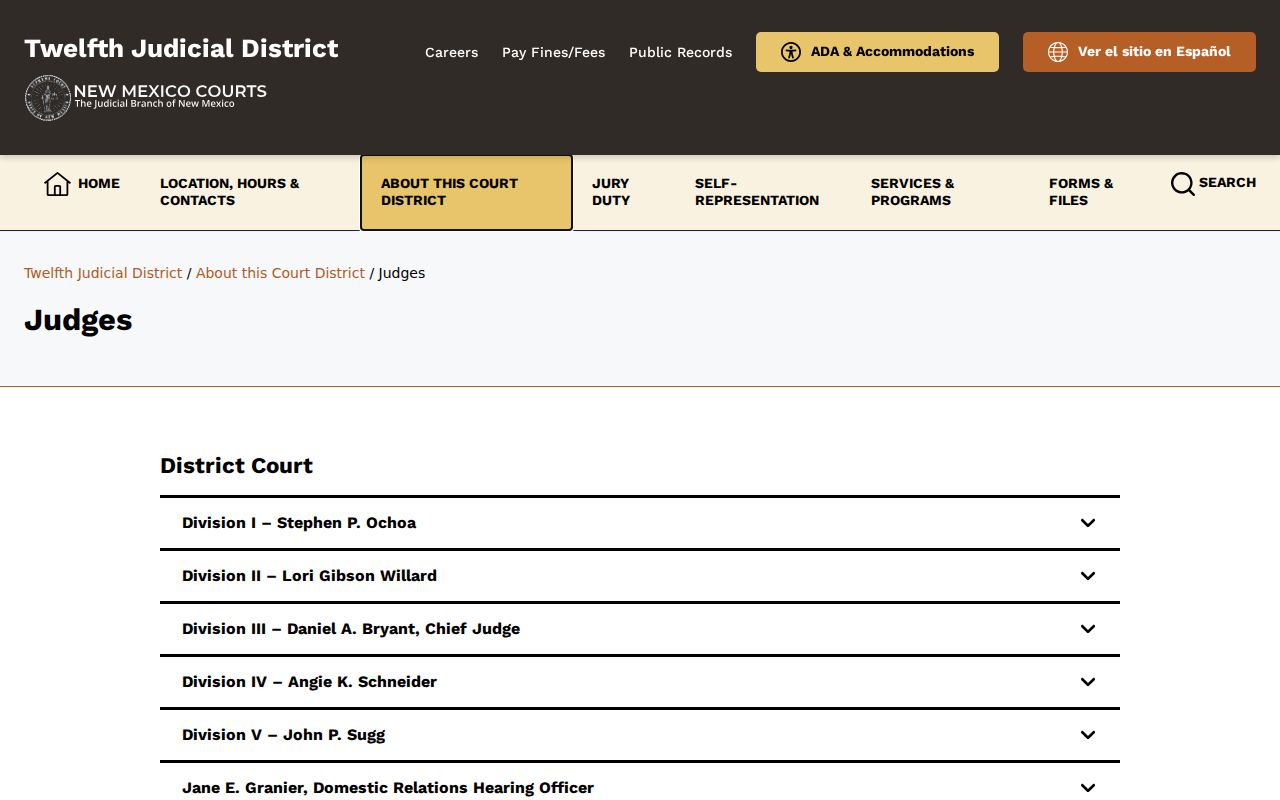
The image is a court-structure reference, not a case result. It underlines one task: pick the right Otero criminal court before reading a docket.
Criminal Dockets: What They Show
The clerk-maintained register is a chronological list of public case activity. It is not normally a file of document images. A public criminal result can identify the case number. It also shows the court and location, the category, public parties, case status, and dated activity. Settings, motions, pleas, judgments, sentences, or appeal entries may appear too. What you see online varies. It depends on digitization, redaction, and the access policy.
| Case number | The complete court, category, year, and sequence identifier used by the clerk. |
|---|---|
| Court and category | Otero District, Alamogordo Magistrate, or a municipal court, with CR or another live category label. |
| Register activity | Dated filings, notices, hearings, pleas, orders, judgments, sentences, and other public entries. |
| Setting | Date, time, courtroom or division, and setting type when the court displays them. |
| Disposition | A recorded outcome such as dismissal, conviction, conditional result, or other closure, read with its actual entry or order. |
A register proves no single fact by itself. When you need an indictment, judgment, sentence, or hearing audio, use the Otero records process. That is the way to the underlying item. The statewide public explanation confirms it. Case Lookup gives a case summary, not the full document file.
Note: a public criminal docket entry identifies court activity. The court-held document supplies the complete text and any authorized certification.
Otero Magistrate Criminal Proceedings
Alamogordo Magistrate Court sits at 263 Robert H. Bradley Drive. It keeps its own docket for misdemeanors, DWI, traffic matters, and felony preliminary proceedings. It is the first stop for a state citation or any lower-court criminal matter. A felony may move to District Court later. Municipal courts run separate city ordinance, petty-misdemeanor, DWI/DUI, and city traffic dockets.
The official Otero Magistrate schedule and the separate Otero District schedule cover the current day. They also span the six following days. They are near-term calendars, not historic name searches. The court warns that entries can have omissions and offers no warranty, so compare any line with the register and written notice before relying on it.
The Magistrate Court's published schedule is the official source. That schedule backs this Otero criminal docket calendar image.
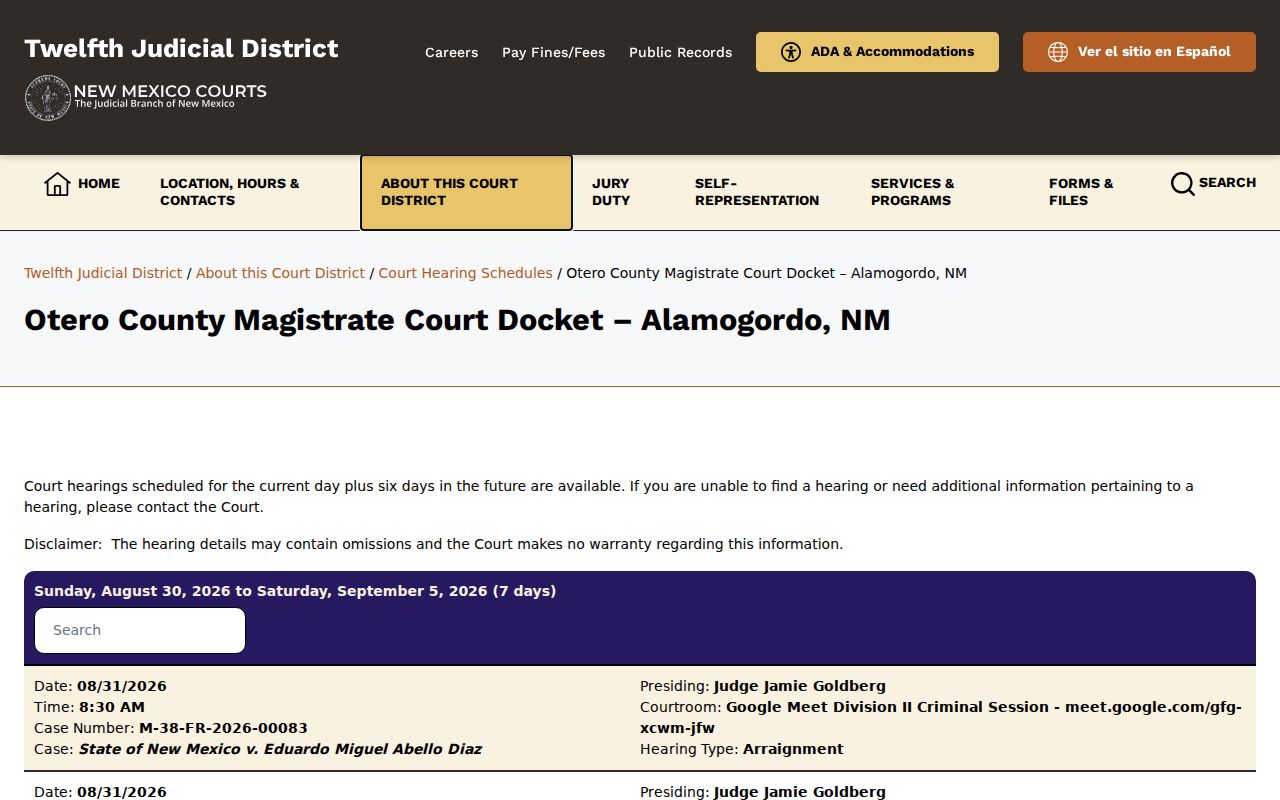
The calendar window is short. Confirm an older or missing setting with the Magistrate Clerk rather than reading it as a final result.
Criminal Case Stages on the Docket
Read criminal entries in date order. A docket may open with a complaint, citation, indictment, or information. The trail then moves on. It can run through first appearance or arraignment, a plea, bond or release activity, motions, hearing notices, orders, and a later outcome. A preliminary hearing is an early lower-court step in a felony matter. Do not confuse it with the later District Court trial docket.
Docket flow: Filing → Arraignment → Pretrial → Plea or Trial → Disposition → Sentencing.
- Arraignment
- An appearance where the charge and plea process are addressed.
- Continuance
- A request or order that reschedules a court date.
- Disposition
- The recorded outcome or closure status, which should be read with the actual entry.
- Judgment and sentence
- The court document to request when the register alone does not supply the needed detail.
A plea entry is not automatically a final outcome. An indictment or information is not a conviction. Otero publishes no criminal docket-code dictionary, so confirm a short code with the clerk rather than guessing from common court shorthand.
Otero Criminal Docket Caseload Context
How busy are the criminal courts handling Otero County? The 2024 New Mexico Judiciary annual report offers a clue. It counts 4,539 new, reactivated, or reopened cases across the Twelfth Judicial District in FY2024, and its case-mix graphic puts adult criminal matters at 39 percent. Those are district-wide numbers. Lincoln and Otero counties are combined in them, so no one can carve out an Otero-only criminal total from the report.
Treat the caseload figures as background only. A docket search is still venue-specific. Start with the court and location printed on the case paperwork, then work through the entry history for that one matter. One more caution: the annual-report numbers describe the whole two-county Twelfth District, so they are not an Otero-only criminal filing count.
Otero County Criminal Docket Courts
For felony trials and post-charge felony dockets, the custodian is District Court at 1000 New York Avenue. Alamogordo Magistrate Court at 263 Robert H. Bradley Drive handles misdemeanors, DWI, and state traffic matters. It also handles felony preliminary proceedings. Follow the court, not the vague phrase "county clerk."
Municipal cases are different. The municipal clerk keeps them for Alamogordo, Cloudcroft, or Tularosa. A statewide search can be a handy first stop. But the public-access materials warn that municipal data is limited and never a complete city-court file. Route a citation issued under city authority straight to that city court.
Appeals need care too. Keep the originating case number. Then ask the original court whether a new docket has been opened. District Court appeals ordinarily travel into the statewide appellate structure. Lower-court appeals can create a new District Court entry.
Otero Criminal Docket Copy Requests
Sometimes the public register lacks the document you need. A judgment, sentence, charge document, or audio can be requested with the Otero records request form, filed through the Otero District Court Clerk's Office. Requests go in person, by mail, or by fax. Include the full name of one or both parties, the case number when known, and an approximate filing date. The clerk calculates the charge and wants payment before processing anything.
The published District Court fees are $0.35 per copied page, plus $1.50 for certification or $4.50 for exemplification per pleading. A hearing audio CD costs $4. Want a mailed result? Enclose a stamped, self-addressed envelope. The District Court accepts cash, money order, and cashier's check, with no personal checks or credit cards for this process.
Before submitting, it helps to gather your search details. The official legacy Case Lookup form lays out the name, case-number, court, category, and date controls behind this Otero criminal docket search image.
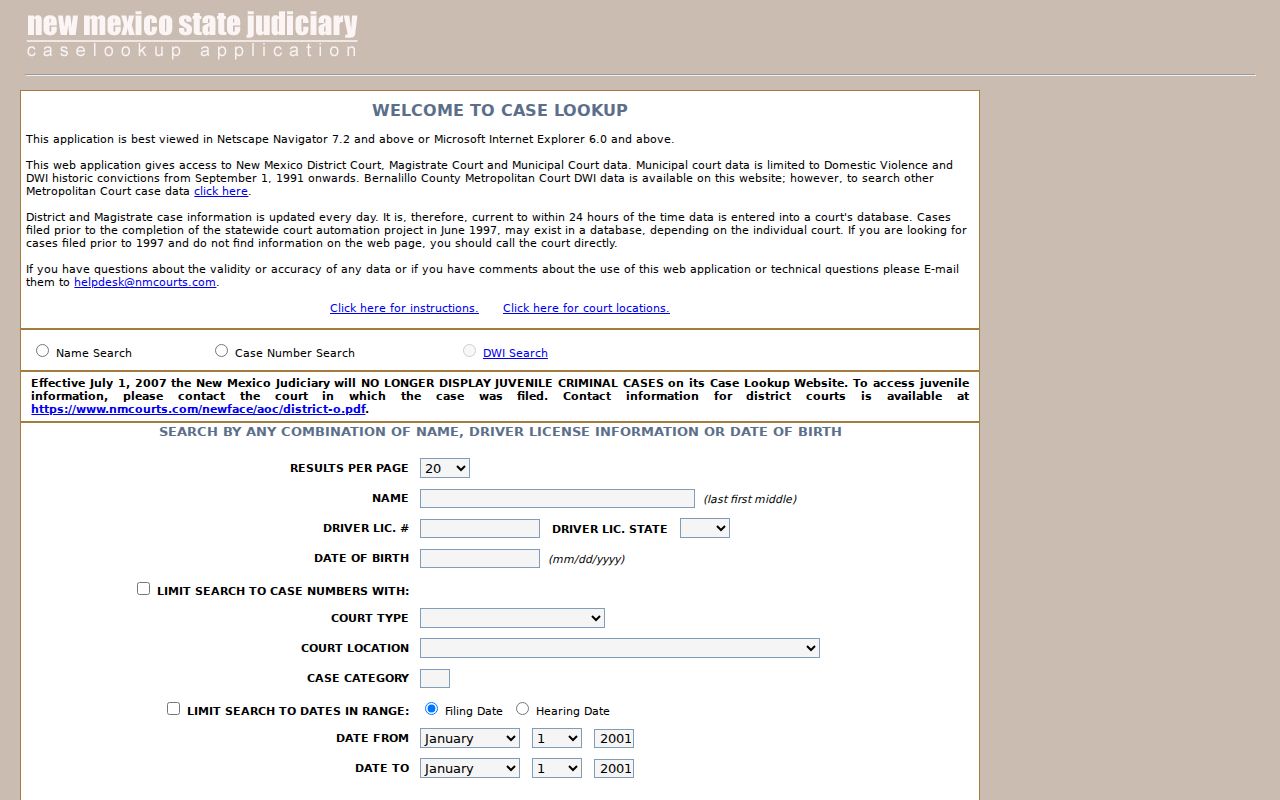
The form image works well as a checklist. Use it to gather search details. For live labels and required controls, rely on the current Case Lookup screen instead.
Also worth knowing: the public criminal register is free to search. A certified copy request, by contrast, needs the clerk's processing route and the published fee.
Otero Criminal Docket Access Levels
Case Lookup is the free public register layer. Registered re:SearchNM access is a separate, account-based channel. Its reach depends on the user's profile. It can reach broader civil, criminal, family, probate, district, magistrate, metropolitan, and appellate information. No account gets a promise of every document or every restricted record.
The New Mexico public-access explanation distinguishes the public search from registered access. It also describes the migration from SOPA. The public path stays the practical first search for most people. Some records are not shown. For those, or for older files, the clerk is the next stop. For an unsealed file, the District FAQ permits inspection in staff presence.
New Mexico Courts' public-access explanation is the source for this Otero criminal docket access image.
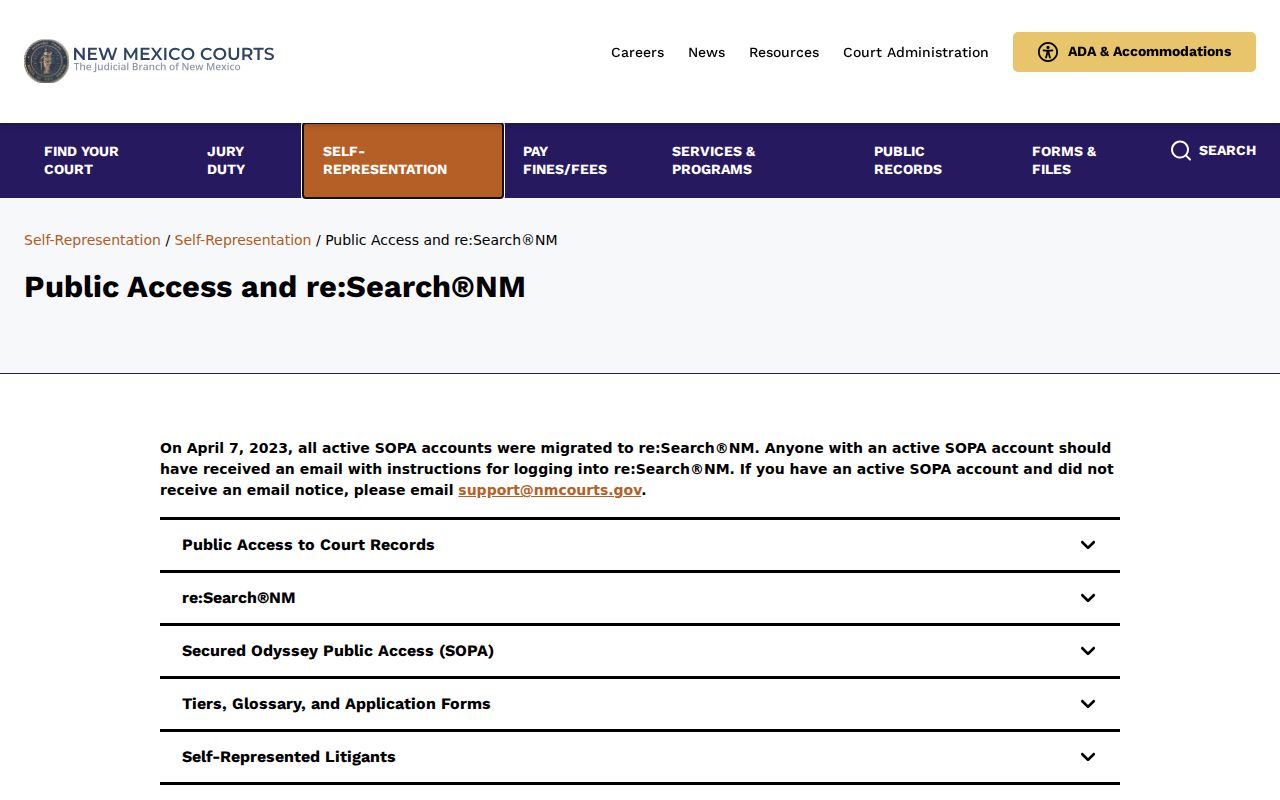
The official comparison is blunt about one thing. Access depends on the service used and the status of the record, not on a single universal online file.
Access Rules for Criminal Dockets
Rule 1-079 NMRA presumes court records, docket and register entries included, are open unless a rule, statute, or order protects them. The same rule requires protection of specified identifiers. Beyond that, the statewide Case Access Policy layers on redaction rules, digitization limits, sealed and confidential-record limits, and a flat prohibition on bulk downloading.
Public-access limits: Juvenile criminal information, protected identifiers, sealed or confidential matters, and some sensitive categories may be absent, redacted, or marked as restricted.
New Mexico Courts IPRA instructions describe a formal route for inspecting public judicial records with the proper custodian.
An absent result is not proof that no case exists. Check the court and category first. Then call District Court at 575-437-7310. Use criminal extensions 100, 104, or 158 when appropriate. Or call Magistrate Court at 575-437-9000 for the lawful access route. A narrow request works best. Name the Otero court, the case number or year if known, the document sought, and the format you want.
One limit to remember: the clerk can explain a permitted route to an unsealed record. The clerk cannot disclose sealed material or give legal advice about a criminal case.